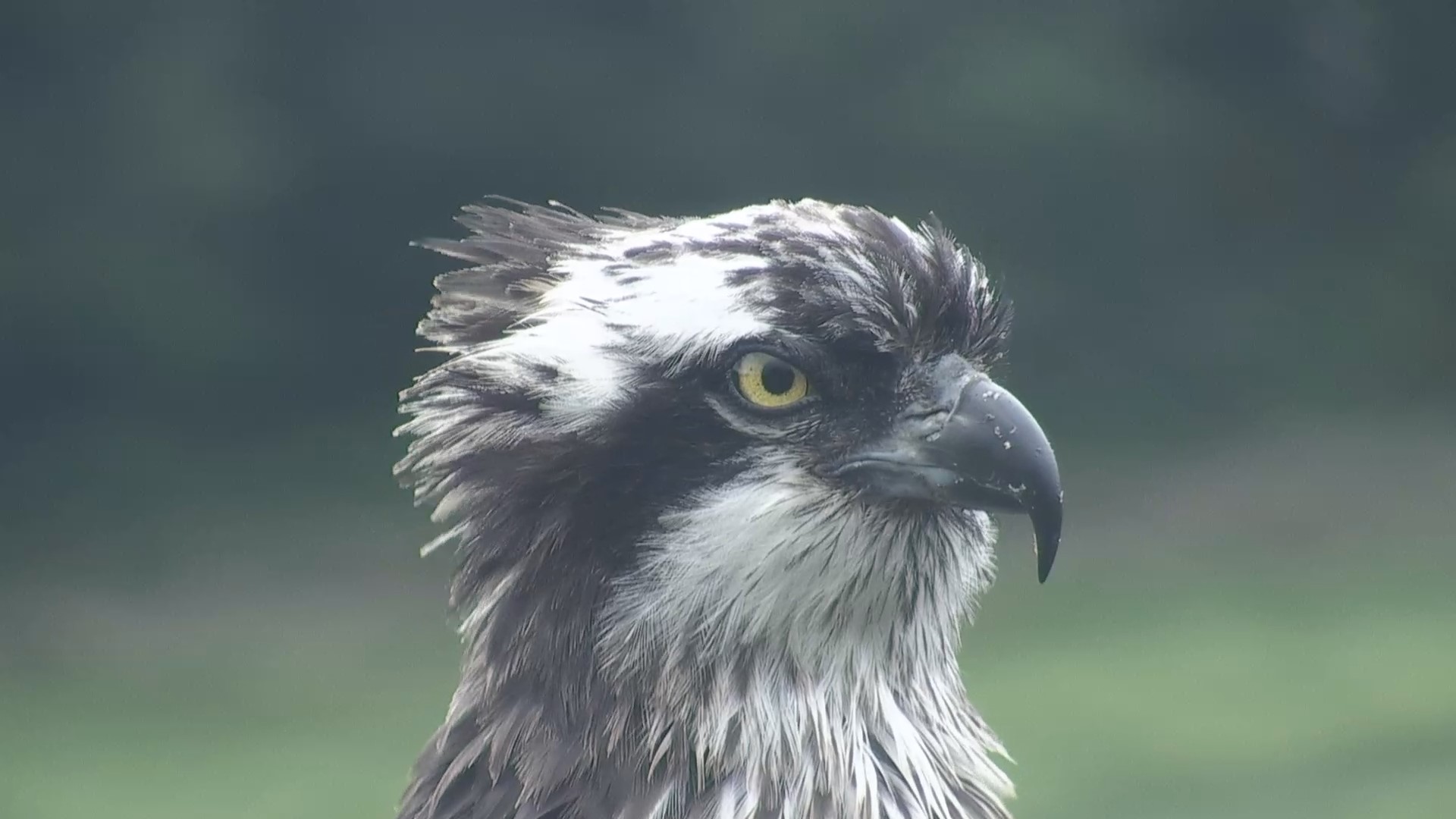
2018
The first Osprey to be seen at Glaslyn in 2018 was Rutland born Blue 24, who being the first osprey back in Wales was doing a “grand-tour” of all the Welsh osprey nests looking out for potential nesting opportunities. Mrs G had settled to being an early returning Osprey after 2009 and we usually expected to see her by 25thMarch at the latest, but when she had still not returned on the 31stMarch, we began to become very concerned. Several other ospreys were late though, so we still had hope.
Blue 24 was looking comfortable on the Glaslyn nest on 1stApril when suddenly we heard intruder chipping and we saw Blue 24 hastily leave the nest. A very defensive looking unringed osprey took her place and much to the delight and relief of everyone that was in the Visitor Centre that Sunday afternoon we realised that Mrs G was home. On the evening of Thursday 5thApril Mrs G was joined by Aran and they soon began the bonding process once again. The first egg was laid on 19thApril, followed by a second on 22ndApril and third on 25thApril. The first chick hatched 36 days later on 25thMay, followed by the second on 27thMay and finally the third on 29thMay.
It turned out to be a very warm summer and as the chicks developed into little Ospreys, they hardly saw a drop of rain. Mrs G spent much of her time mantling over them to keep them sheltered from the warm sun. Aran bought some unusual catches back at the nest and we saw five Tench delivered during late June. We also saw singles of Perch and Roach delivered during the same period. It suggested that the warm weather had caused Aran to fish different areas to his usual haunts.
Tony Cross ringed the three chicks in the nest once again on 2ndJuly. The eldest was a female, ringed Blue KS3, the middle chick another female Blue KS1 and the youngest chick was a male, Blue KS2. The eldest chick was supposed to have been given the ring with KS0 on it, but for some reason it would not stick, so a spare ring was used instead. Hence the fact they were slightly out of sequence.

As the chicks grew it became apparent that the middle chick, KS1 was the dominant one of the brood and she was the first to fledge the nest on 19thJuly. KS3 followed her younger sister on 20thJuly, just as the first rains began to fall after the long heatwave. KS2 joined his sisters in the air on 21stJuly.
As the weeks went on KS1 continued to become more dominant over her siblings when fish were delivered by Aran. She even challenged her mother on occasions! We witnessed KS1 building small piles of fish (as many as four) and standing on top of them, refusing to let anyone take them from underneath her. We had not witnessed this behaviour in the Glaslyn nest previously.
Mrs G was last seen on 2ndSeptember and KS1 left on 4thSeptember. Finally, the other two chicks could start to feed up on the fish Aran bought back to the nest, as they had missed out on meals while their sister was grabbing the deliveries before they had the chance to eat. Just as we thought they were ready to leave the nest and start their migration South, the wind direction changed and the unfavourable winds forced them to stay a few more days. On 21stSeptember the wind changed direction once again and finally KS3 and KS1 both began their journey South. Aran remained around the nest territory for a further day and on the evening of 22ndSeptember we saw him fly towards the estuary for the last time.
2019
In 2019 we were thrilled to see Mrs G arrive back around her usual date, returning on 25thMarch. Aran arrived back on 1stApril, his earliest recorded return to date. Just 12 days later on 13thApril, Mrs G laid the first egg of the season. On 16thApril there were celebrations when the second egg was laid. This was a very special egg, as it was the 50thknown egg that Mrs G had laid during her sixteen breeding seasons. The third egg was laid on 19thApril.
On the morning of Thursday 16thMay, an intruding male osprey began a relentless attack upon the Glaslyn nest. Aran took chase and after a short aerial battle he managed to see the intruder off. The male was identified as Blue Z1 “Tegid” the sole surviving Dyfi offspring from 2016. Later that day Tegid returned and began to attack the nest once again. Aran took chase and we followed the battle in the sky for some time until we lost sight of the two males. Aran had not returned by nightfall. We had not seen Aran bring a fish to the nest since late afternoon on Tuesday 14th, he was probably aware there was another male around and was staying around to defend his nest. We became concerned though, as we knew that was the last time that Mrs G had eaten. During the Friday we occasionally got glimpses of ospreys flying high above the valley, we believed it to be Aran and Tegid, still locked in their territory dispute. Mrs G continued to incubate her precious eggs and still she had not eaten. We knew that ospreys could last without food for 4 or 5 days while crossing the Sahara, so our common sense told us that she should be fine. She had not been using much energy while incubating the eggs for the past 34 days. We were still anxious though and wished that Aran would land back on the nest. Finally, at 07:57 on Saturday 18thMay Aran landed back on the Glaslyn nest and Mrs G was able to take a proper break from incubation and stretch her wings. Just over an hour later Aran left, we hoped it was to get a fish. He returned with a headless Brown Trout just after 11am, to huge cheers in the crowded Visitor Centre.

The next day first chick hatched after 36 days of incubation, the second chick hatched on 21stMay after only 35 days of incubation. The third chick was also incubated for 35 days, hatching on 24thMay. The three chicks were well provided for by Aran and seemed to do well for a couple of weeks, but on the 6th/7thJune the second chick began to become unwell. It vomited blood over Mrs G’s chest and we watched on helpless to do anything but hope. By Saturday morning the middle chick was looking very sick and weak. We had a glimmer of hope during the afternoon when it did manage to take a few bites of food, but it was short lived. The following morning at 07:30 the sick chick breathed its last breath. It was the first time we had lost a chick on the Glaslyn nest since 2007 and we were all devastated.
Just as we thought things could not get any worse, the youngest chick, who had only just started moving around the nest, reached up to take a morsel of fish from Aran and lost her footing on a loose twig. Somehow, she had managed to fall between a steep part of the nest cup and her dead sibling. She was stuck upside down on her back and no matter how much she tried, she could not right herself. After watching her fighting for her life for more than four hours we made the decision to intervene. It is something we have never had to consider before at Glaslyn and it was one of the most difficult decisions we have ever had to make. In just 30 minutes she was back on her feet and the body of the dead chick was removed at the same time and sent for post mortem.
The post mortem report concluded that the cause of Chick 2’s death appeared to be pneumonia and lung haemorrhage associated with lungworm infestation, together with acute blood loss anaemia. The report also indicated that the middle chick was likely to have been a female. The unfortunate events of Sunday 9thJune will remain with us for many years.
The other two chicks thrived however, and on 24thJune Tony Cross fitted them with their leg rings. KA4 the eldest of the two and KA0 the youngest. KA4 should have been fitted with the KS0 ring, but for the second year running the glue would not stick. The ring has been destroyed as there was clearly something not quite right with it. Both surviving chicks were also judged to be females.
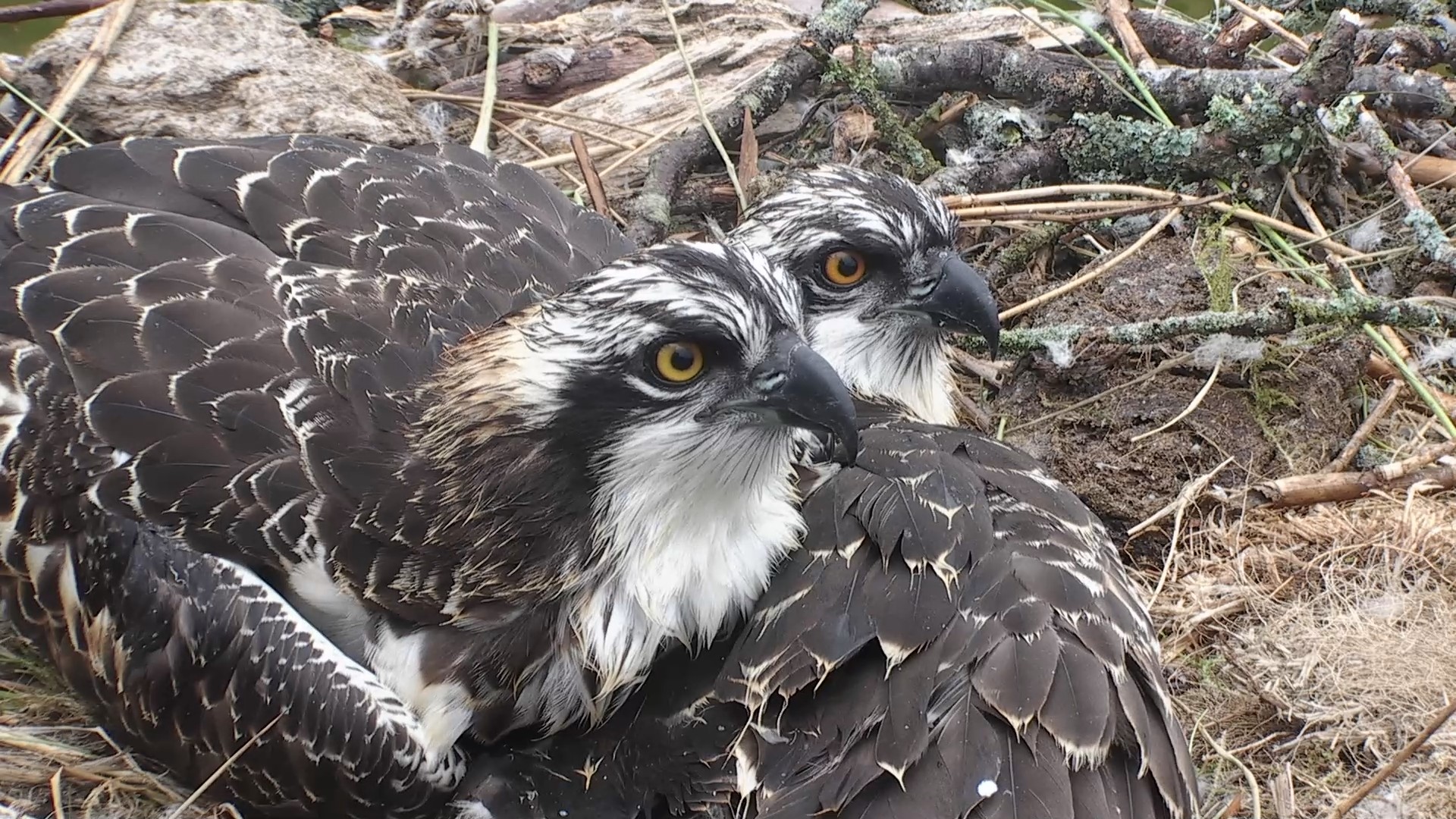
KA4 fledged the nest on 13thJuly at 55 days old. KA0 stayed in the nest for quite a while longer, finally leaving the nest perimeters on 22ndJuly at 59 days old. She now holds the record for the slowest chick to leave the Glaslyn nest. Perhaps the earlier fall made her lose some confidence, although once she discovered her wings, she became very confident in the air and was often seen flying around the valley with her sister.
KA4 was the first to leave the valley and we last saw her on 4thSeptember. Mrs G was the next to leave on 9thSeptember. KA0 seemed reluctant to leave the regular supply of fish Aran was continuing to deliver to her and we saw her for the last time at first light on 16thSeptember. We had our last glimpse of Aran later that afternoon. He flew over the Visitor Centre carrying a fish, circled the nest site and on finding no offspring calling for food he took his meal to a favourite tree to eat his supper. That was the last sighting we had of an Osprey in the Glaslyn Valley during 2019.